
The Basics
Understanding Subaru Airbag Systems
Subaru calls its airbag setup the Supplemental Restraint System, or SRS. The word "supplemental" matters: airbags are designed to work alongside seatbelts, not replace them. Together they manage how an occupant's body slows down during a crash.
The system has four main groups of parts. Airbags sit in the steering wheel, dashboard, seats, roof rails, and in some models the lower dash for knee protection. Seatbelt pretensioners use a small pyrotechnic charge to pull belt slack tight in the first milliseconds of an impact. Sensors around the vehicle measure deceleration and, in the front passenger seat, whether someone is sitting there and roughly how much they weigh.
At the center is the restraint control module. It constantly checks every circuit, decides in a fraction of a second whether a crash is severe enough to deploy, and records information about events it detects. If anything in that network looks wrong, the module turns on the warning light.
Warning Signs
What Does the Subaru Airbag Warning Light Mean?
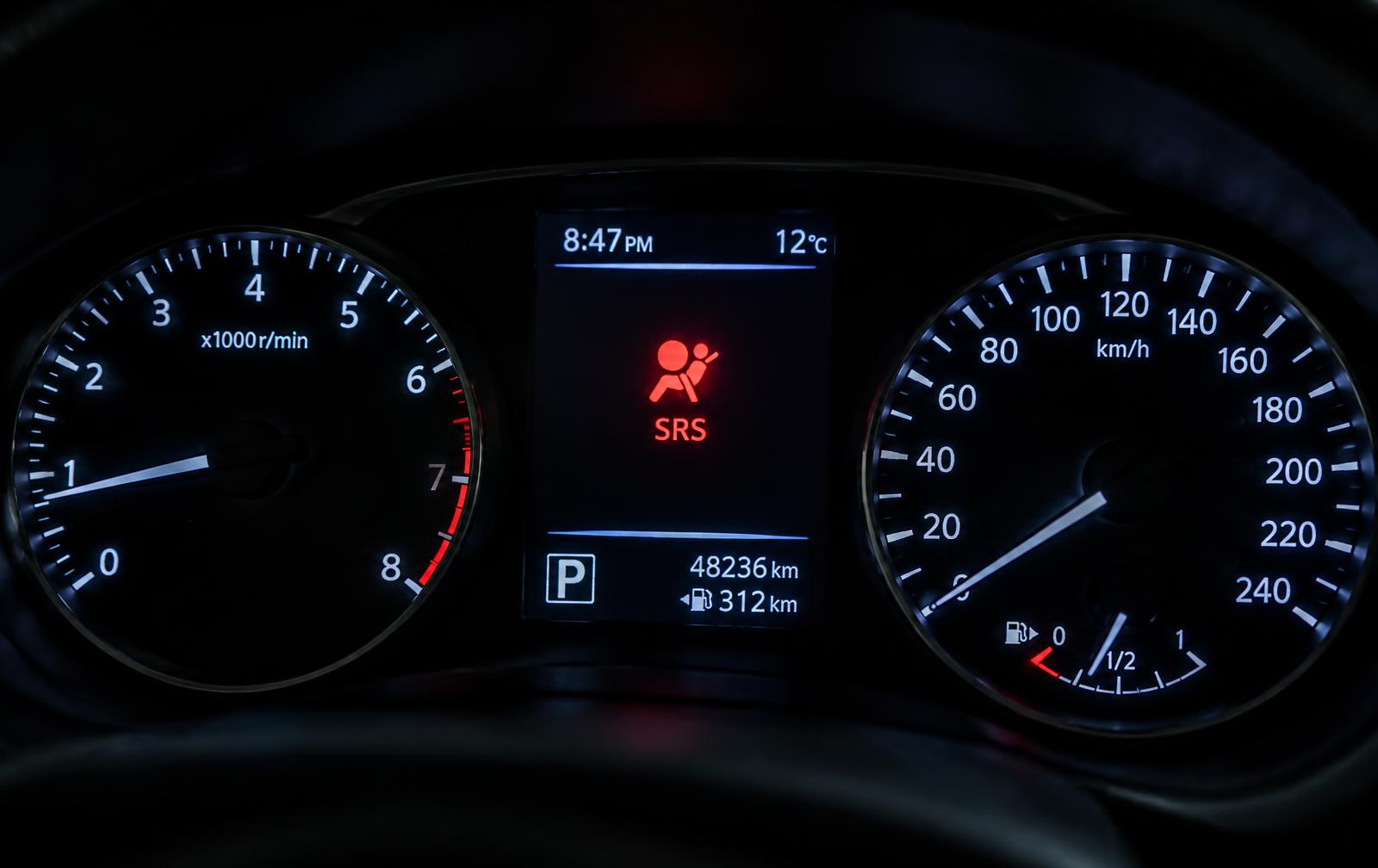
When you start the car, the airbag light should glow for a few seconds while the module runs a self-check, then go out. If it stays on, flashes, or appears while driving, the module has stored a fault code.
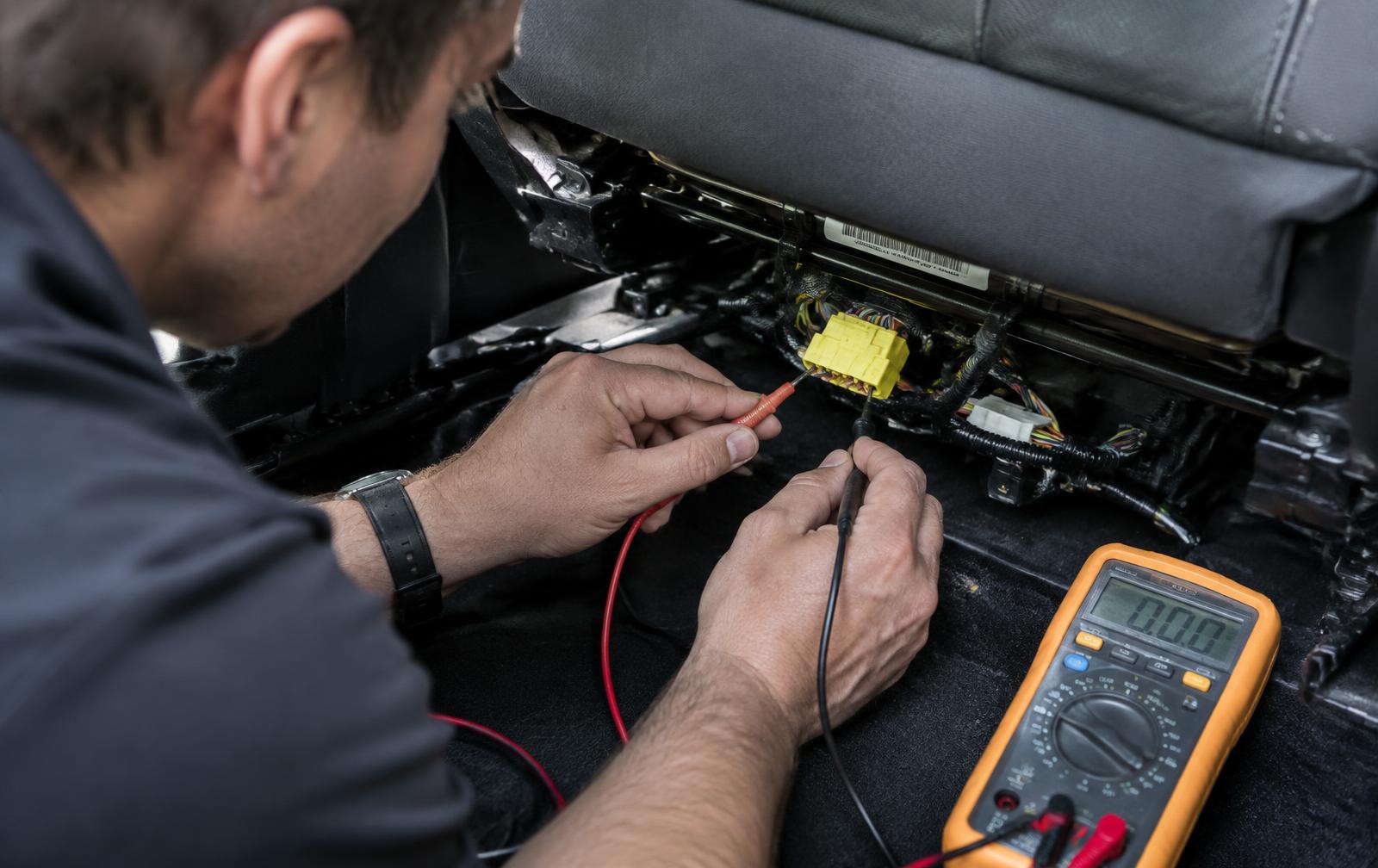
Those codes cover a wide range of possibilities. A connector under the driver's seat may have been bumped while vacuuming. A clock spring — the coiled ribbon that keeps the steering-wheel airbag connected as you turn — may have worn through. A passenger occupant sensor might be reporting unreliable data, or the module itself may have an internal fault.
The point is that the light is a general alert, not a diagnosis. Two cars with the same warning light can have entirely different problems.
After an Impact
What Happens to an Airbag Module After a Collision?
During a collision, the restraint control module evaluates sensor signals and may store crash-related records. Depending on the severity and the module design, those records can remain in memory after the event, and some of them are not meant to be erased by an ordinary scan tool.
Deployment is not the only trigger. A moderate impact can fire pretensioners without deploying airbags, or simply register an event that keeps the system in a fault state. Sensors near the point of impact and wiring routed through damaged panels can also be affected.
That is why a thorough inspection after any significant collision is important. The goal is to confirm that every deployed or damaged component is replaced, every circuit tests correctly, and the module is in a condition to protect occupants the next time it is needed.
Module Service
Subaru Airbag Module Reset Explained
People often use the phrase "airbag module reset" to describe the process of returning a restraint control module to normal operation after crash data has been stored. In practice, it is better understood as an assessment rather than a simple button press.
A responsible process starts with reading the stored data and fault codes, then confirming the module's internal condition and part identification. Only then can a technician determine whether the module can be properly serviced or whether replacement is required. Some modules can be restored where technically feasible and allowed; others cannot, and a module with internal damage or certain types of recorded events should be replaced.
Not every module can be reset, and it should never be treated as a shortcut around repairing the rest of the system. Deployed airbags, fired pretensioners, and damaged sensors still need to be addressed, and the full system must pass verification once the work is done.
The Lineup
Subaru Models and SRS Systems
Every current Subaru uses a restraint control module, but the details differ. Sensor placement, connector styles, module part numbers, and repair procedures change between generations — and sometimes within a single generation depending on trim and options.
Subaru Outback
A popular family wagon with front, side-curtain, and knee airbags plus occupant detection in the front passenger seat on many years.
Subaru Forester
Compact SUV whose SRS layout has evolved across generations, with seat-mounted side airbags and pretensioners for front occupants.
Subaru Crosstrek
Shares much of its platform with the Impreza, so restraint components and wiring routing are often closely related.
Subaru Impreza
Available as sedan and hatchback, with configurations that differ by model year and trim level.
Subaru WRX
Performance-oriented, yet equipped with the same safety-critical restraint control principles as the rest of the lineup.
Subaru Legacy
Midsize sedan with a full suite of frontal, side, and curtain airbags managed by a central control unit.
Subaru Ascent
Three-row SUV with additional curtain coverage and more seating positions monitored by the restraint system.
Because system design and repair requirements vary by model year and configuration, the correct information for one vehicle may not apply to another, even if they look similar.
Common Faults
Common Subaru Electrical and Airbag Warning Issues
Most airbag warnings trace back to a handful of familiar sources. Knowing them can make a conversation with a technician more productive.
SRS warning lights
The most visible symptom. The light indicates the system has detected a condition it cannot confirm as normal.
Airbag sensor faults
Impact and occupant sensors can fail internally or report implausible values after moisture or physical damage.
Seatbelt pretensioner faults
Pretensioners are pyrotechnic devices; once deployed or damaged they register a fault and must be addressed.
Wiring and connector problems
Under-seat connectors and steering clock springs are frequent culprits, especially after seat removal or wear.
Battery voltage issues
Low or unstable voltage during starting can trigger stored codes that point to a supply problem rather than a failed part.
Restraint control module faults
Internal module faults or stored crash records may prevent the system from returning to a ready state.
Doing It Right
Why Professional SRS Diagnostics Matter
Airbag systems are among the most safety-critical electronics in a vehicle, and they are designed to be difficult to tamper with for good reason. Effective diagnosis depends on manufacturer-specific information: wiring diagrams, component specifications, and the exact test procedures for that model.
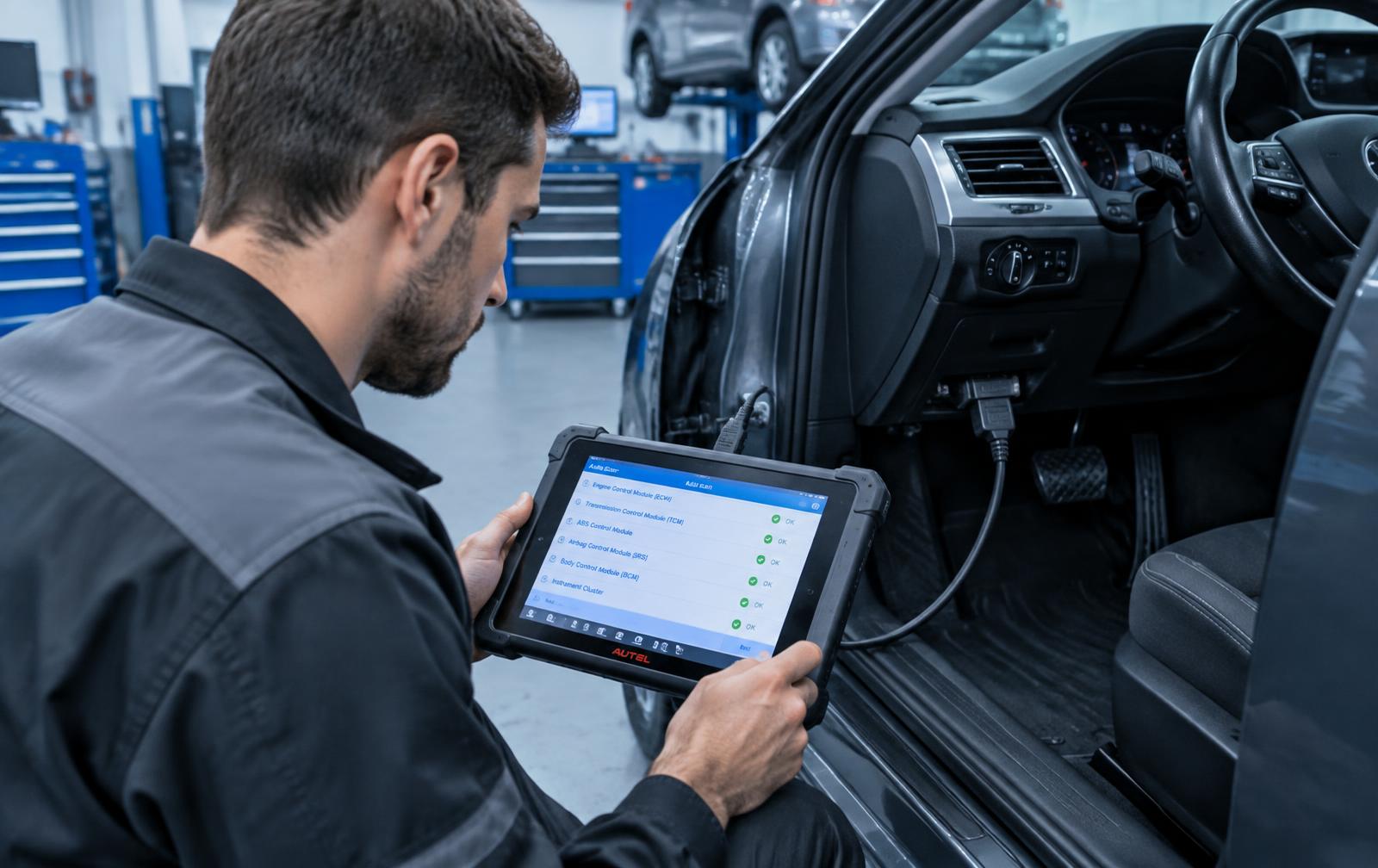
It also depends on the right tools. Generic code readers often cannot see the SRS module at all, and even a capable scanner only provides a starting point. Fault codes have to be interpreted in context — a code for a resistance problem might point to a connector, a harness, or the component itself.
Finally, post-repair verification matters as much as the repair. The system should complete its self-check cleanly, show no stored or pending codes, and behave correctly over a test drive. Airbags should never be bypassed or disabled, and warning lights should never be silenced without fixing the underlying cause. Any repair should follow manufacturer procedures and be verified by a qualified professional.
Local Guidance
Sacramento Automotive Repair Considerations
Sacramento has a large Subaru-owning community, from daily commuters on I-80 and Highway 50 to drivers heading up to the Sierra on weekends. Summer heat in the Central Valley can stress batteries and wiring, and a weak battery is a surprisingly common source of stored SRS codes.
When choosing an automotive electrical diagnostic professional in the Sacramento area, a few questions are worth asking:
- Do they have scan equipment that can communicate with Subaru SRS modules?
- Do they work from manufacturer repair information for your specific model year?
- Will they explain what the fault codes mean and what testing confirmed the cause?
- Do they verify the complete restraint system after repairs, not just clear the light?
- Are they clear about when a module can be serviced and when replacement is required?
A good shop will be comfortable with these questions and give you straightforward answers in writing before work begins.
Questions
Frequently Asked Questions
Why is my Subaru airbag light on?
The airbag light comes on when the restraint control module detects a fault it cannot clear on its own. Common causes include a loose or corroded connector under a front seat, a worn clock spring in the steering column, a failed occupant or impact sensor, a seatbelt pretensioner fault, low battery voltage, or crash data stored in the module after a collision. The light itself does not tell you which of these is responsible, so the stored fault codes need to be read and interpreted.
Can a Subaru airbag module be reset after a collision?
Sometimes, but not always. Certain modules that have recorded a crash event may be evaluated and returned to service where that is technically possible and permitted, while others must be replaced. The answer depends on the specific module, the kind of event recorded, the module's internal condition, and the manufacturer's repair guidance. A qualified professional should make that determination, and the full system must be verified afterward.
Does an airbag module always need replacement?
No. If the module itself is healthy and the warning is caused by a sensor, wiring, or connector issue, the module may not need any work at all. Replacement becomes necessary when the module has internal faults, has been physically damaged, or cannot be properly restored according to applicable procedures.
What happens if the SRS warning light stays on?
When the SRS light remains illuminated, you should assume some or all of the restraint system may not work as designed in a crash. Airbags might not deploy, or pretensioners might not tighten. It is wise to have the vehicle diagnosed promptly rather than driving for an extended period with the warning active.
Can a diagnostic scanner identify an airbag system fault?
A scan tool capable of communicating with the Subaru SRS module can read stored and current fault codes and live data. Generic code readers often cannot access the airbag system. Even with the right tool, the codes are a starting point; the technician still needs wiring diagrams, test procedures, and experience to confirm the actual cause.
Which Subaru models use SRS airbag control modules?
All modern Subaru models — including the Outback, Forester, Crosstrek, Impreza, WRX, Legacy, and Ascent — use a supplemental restraint system managed by a control module. Module part numbers, sensor layouts, and repair requirements vary by model year and configuration.
Why should the airbag system be checked after an accident?
Even a collision that did not deploy the airbags may have triggered pretensioners, stored event data, or damaged sensors and wiring. A post-accident inspection helps confirm that every component is ready to work in a future crash, which is the whole purpose of the system.
Conclusion
Final Thoughts
An airbag warning light is easy to ignore, especially when the car seems to drive normally. But the restraint system only proves its value in the moment you need it most, and there is no second chance to get it right.
Accurate diagnosis separates a simple connector fix from a module that genuinely needs replacement. Proper repair, done to manufacturer procedures and verified afterward, means your Subaru's airbags and pretensioners are ready to do their job. That peace of mind is worth the time it takes to do the work correctly.